
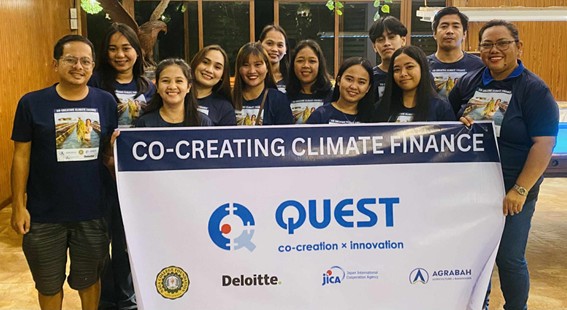
The Quest Co-Creation Project team recently held a capacity building and fellowship session, bringing together project staff from Caramoan Camarines Sur and those deployed in Naga. This gathering fostered collaboration, shared learning, and strengthened the collective mission of driving climate innovation at the community level.
1. The Motivation Behind Establishing This Collaborative Project
Every nation today speaks of achieving net-zero carbon emissions by 2050, yet a fundamental challenge persists—you cannot manage what you cannot measure.
In the Philippines, publicly listed companies are required to conduct carbon reporting under the Securities and Exchange Commission’s (SEC) Sustainability Reporting Guidelines for Publicly-Listed Companies (Memorandum Circular No. 4, series of 2019), which mandates the submission of an annual sustainability report alongside their financial filings. However, 99.6% of all businesses in the country are micro, small, and medium enterprises (MSMEs). According to the Department of Trade and Industry (DTI), as of 2023, there were 1,246,373 business enterprises, of which 1,241,733 (99.63%) were MSMEs.
Despite their scale and importance, MSME emissions remain largely invisible. Agrabah Ventures estimates that MSMEs collectively contribute approximately 70 million metric tons of CO₂e annually, based on approximations derived from DTI and Philippine Statistics Authority (PSA) data and their proportional share in national business-sector activity. For context, the PSA reported the Philippines’ total greenhouse gas (GHG) emissions at 204.33 teragrams of CO₂e (Tg CO₂e) in 2020. Yet, there is no official or disaggregated data capturing the emissions of MSMEs, underscoring the urgent need for reliable measurement, reporting, and validation systems.
This data gap is not unique to the Philippines. Across ASEAN, MSMEs form the backbone of national economies, but their carbon footprints remain unaccounted for in most national climate frameworks.
Recognizing this gap, Agrabah Ventures, recipient of the ASEAN Business Awards 2023 Net Zero Award, has leveraged its expertise in carbon sequestration and carbon offsetting to design a localized, inclusive solution. Existing global carbon accounting standards are often misaligned with developing economies where MSMEs dominate. To address this, Agrabah developed the Net Zero Policy Framework—a model tailored to the Philippine context that localizes carbon calculation, reduction, and offsetting for both enterprises and farming communities.
Supporting this vision, the Naga College Foundation (NCF) Center for Research, Training, and Development, led by Dr. Regina Valencia, will spearhead the evidence-based research component of the project. The Center will compile and validate local studies and data on carbon sequestration, emissions sources, and measurement methodologies, bridging scientific rigor with community-driven sustainability practices to strengthen local climate action.
2. Overview of the Collaborative Project
The QUEST Co-Creation Project aims to pilot a policy-driven, nature-based solution for a Local Carbon Accreditation and Credit Framework. The project’s proof of concept will demonstrate how farmers and MSMEs can measure, validate, and monetize their carbon sequestration or reduction activities through a locally endorsed carbon policy.
This initiative combines Agrabah’s expertise in nature-based climate solutions with the research and technical capabilities of the NCF Center for Research, Training, and Development. Together, they are designing a science-based, community-adaptive model for carbon measurement, reporting, and verification (MRV) that aligns with the needs of local governments and grassroots enterprises.
The approach is policy-driven, evidence-based, and inclusive, aiming to make carbon accounting and trading accessible at the local level while promoting climate-resilient livelihoods.
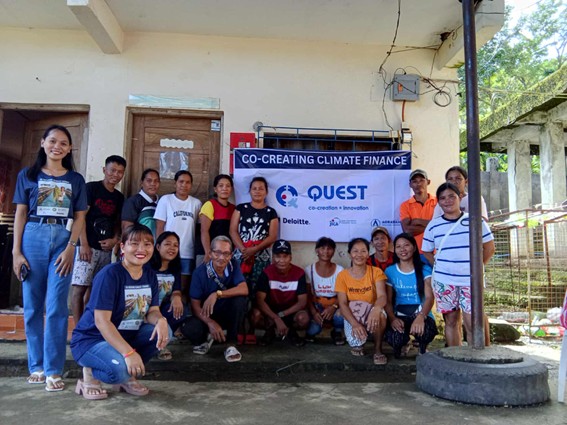
As part of the QUEST Co-Creation by JICA, our project team is now in the process of accrediting farms for carbon credit certification, following the Carbon Accreditation Protocol
3. Introducing the Co-Creation Partners
In addition to our co-creation partner, Naga College Foundation, Inc., this project is being carried out through the collaboration of various stakeholders in the Philippines. The main partners are as follows:
- The Local Government Unit (LGU) of San Jose, Partido,
- The LGU of Naga City,
- The Seaweed Farming Community of Caramoan, Camarines Sur and
- The Metro Naga Chamber of Commerce and Industry (MNCCI).
Together, these partners represent the convergence of policy, academia, private sector innovation, and community participation—the essential pillars of an inclusive net zero transition.
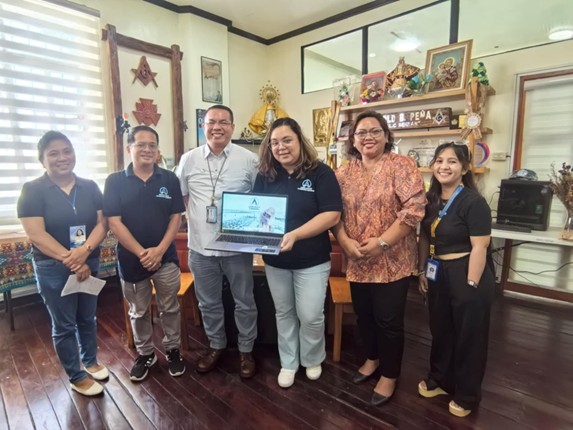
Initial presentation of the Agrabah Carbon+ Project to Mayor Jerold Peña of the Municipality of San Jose Partido, Camarines Sur. From left: Ms. Jayzel Asido, Mr. Jun Ocol, Mayor Jerold Peña, Ms. Jojo Gumino-Ocol, Dr. Regina Valencia, and Ms. Jennifer de Jesus.
4. Message to the Public and Call for Collaboration
The Agrabah–NCF Co-Creation Project is more than a pilot—it is a movement toward measurable and inclusive climate action. By connecting policy design, local governance, research, and livelihood innovation, this initiative seeks to empower every small business and farming community to participate meaningfully in the low-carbon economy.
We invite research institutions, local governments, private companies, and development organizations to collaborate in scaling this initiative. Together, we can create a localized carbon ecosystem that reflects the resilience, ingenuity, and sustainability aspirations of the Filipino people—and serve as a model for ASEAN nations striving toward net zero.
Join us in transforming data into action, policy into impact, and communities into climate champions.