
1. The Motivation Behind Establishing This Collaborative Project
The stratospheric balloon experiment is an educational and research activity that can be conducted collaboratively by multiple universities and colleges of technology (KOSEN). Unlike rocket launches, this experiment does not reach outer space but achieves altitudes of approximately 30 km, reaching the stratosphere. As the balloon rises, it expands and eventually bursts due to decreased air pressure, after which the observation equipment (payload) descends to the ground with an attached parachute. This experiment is considered a gateway to space development.
In Japan, about 70% of the land is mountainous and surrounded by the sea, which often results in payloads landing in the ocean. Once the payload lands on water, ocean currents can cause it to drift, making recovery difficult. Additionally, changes in weather conditions may cause payloads to fall into mountainous areas, sometimes getting caught in trees, resulting in a low recovery rate. In contrast, Mongolia’s vast grasslands allow for safe and highly successful recovery of payloads during stratospheric balloon experiments.
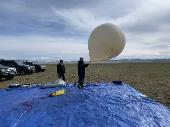 (a) Preparing for Balloon Launch (a) Preparing for Balloon Launch |
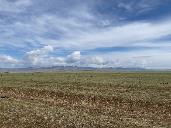 (b) Experimental Environment (b) Experimental Environment |
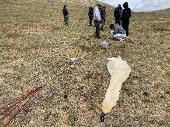 (c) Payload Recovery on Grasslands (c) Payload Recovery on Grasslands |
Figure 1: Stratospheric Balloon Experiment in Mongolia (June 2025)
With this background, this project aims to implement the “Japan-Mongolia Space Education Project,” making use of the strengths of both countries. National Institute of Technology, Kagawa College (Kagawa College) will provide basic payload kits developed through its accumulated know-how to Institute of Engineering and Technology Mongol Kosen College of Technology, MUST College of Technology, and New Mongol College of Technology (hereafter collectively referred to as the “three Mongolian colleges”). Meanwhile, the three Mongolian colleges will provide the experimental environment, and together, both institutions will strive for safe and efficient stratospheric balloon experiments.
2. Overview of the Collaborative Project
 |
 |
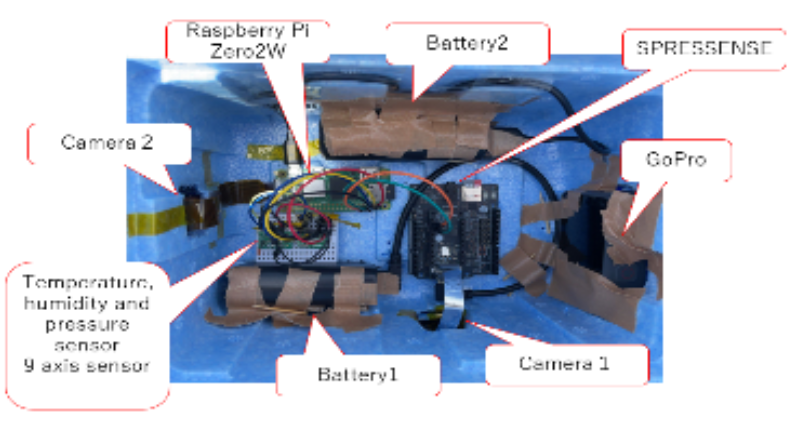
| (a) Internal Structure | (b) External Appearance |
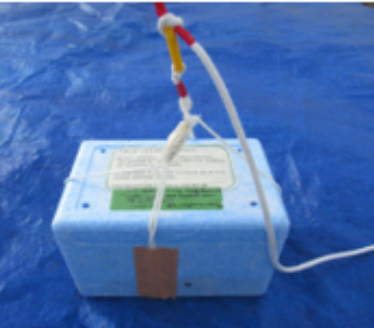
Figure 2: Payload for Stratospheric Balloon Experiment Developed by Kagawa College (Left: Internal Structure, Right: External Appearance)
Figure 2 shows the payload developed by Kagawa College for stratospheric balloon experiments. Equipped with a microcontroller and various sensors, it collects data such as temperature, humidity, pressure, location, and time, and transmits this data to the ground using a LoRa module (compact wireless transmitter). The receiver on the ground can obtain real-time data observed at high altitude.
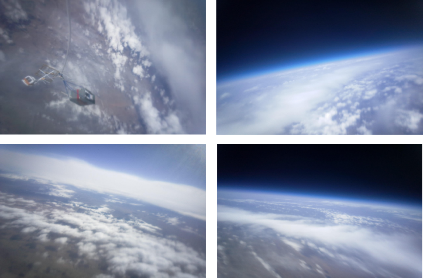
Figure 3: Photo Taken from the Stratosphere by the Payload (June 2025)
Figure 3 shows a photo taken from the stratosphere during a preliminary experiment conducted in Mongolia in June 2025. This project will include a workshop at Kagawa College in December for students in the three Mongolian colleges, focusing on the use of the payload. Afterwards, each college will plan and design its own mission based on the provided payload kit, and conduct the stratospheric balloon experiment in Mongolia in March 2026.
Furthermore, we will prepare a user manual for the payload kit in Mongolian to make it easier for students at the three Mongolian colleges to use.
3. Introduction of Co-Creation Partner
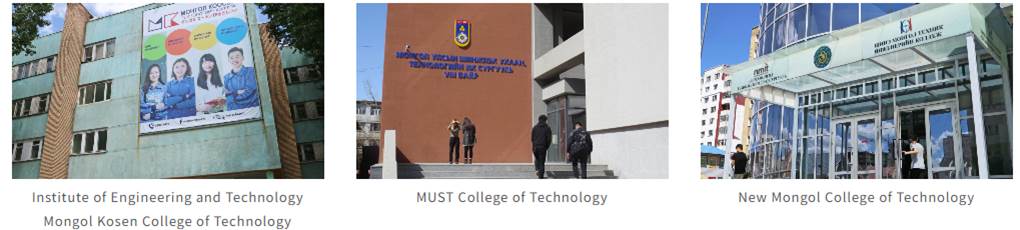 Figure 4: Three Colleges of Technology in Ulaanbaatar
Cited from the KOSEN website ( https://www.kosen-k.go.jp/global/mongolia)
We will collaborate with three colleges of technology in Ulaanbaatar (Institute of Engineering and Technology Mongol Kosen College of Technology, MUST College of Technology, and New Mongol College of Technology) to promote the stratospheric balloon experiment. Workshops and payload kits will be provided to students from each college who wish to participate, supporting the acquisition of fundamental skills necessary for the experiment. Through these efforts, we aim to foster interest and momentum for future satellite development.
4. Message to the Public and Call for Collaboration
The Japan-Mongolia joint balloon experiment is held every March, with participation from university and college students who wish to join. Organizations interested in participating in this demonstration experiment can also receive lectures on how to use the payload kit. If your organization is interested in participating in space education initiatives between Japan and Mongolia, please feel free to contact us.
We believe this initiative serves as an excellent example of international collaborative education.